Saturday, July 23, 2011

I Feel Like a Churro


I’m not ready to go. A complete 180 from my initial posts, questioning my existence in Mexico. But having to say goodbye today to my profesoras, the staff at Casa Hogar, and more importantly the kids, brought tears to my eyes. Over the years I have become more of a crier. Not something I’m proud of, but I think it has something to do with listening to my feelings more. Or maybe I’m just turning into a big baby? Either way, I am wishing I had more time even with the struggles over the last week.

Obviously after two weeks of Spanish courses, I am not going to be fluent. Sorry guys, don’t mean to disappoint. But I do have a solution for this perpetual problema of mine. Stay tuned. Having classes for four hours everyday is intense. My first week was spent solely on grammar and cultural competency topics. It was super organized and well implemented. The second week focused on medical terminology, vocabulary and phrases. This portion was not exactly what I had expected, but we made the best of it. My profesoras Maria and Lupita pushed me, and were always very thorough. I inevitably had moments where I just hit a wall and couldn’t absorb more. Honestly, I’m not sure how much I actually soaked up. It’s like when you powder churros (I’m currently addicted) with tons of sugar and cinnamon, but only so much really sticks. Well in this moment I’d like to think of myself as that churro. I had so much information thrown at me, but it is impossible to hold onto and apply it all. Seeing that I’ve been trying to master Spanish longer than I care to admit, I easily become frustrated with the fact that I still fluctuate between beginner and intermediate… a world away from fluent. But I am trying to redirect my way of thinking and am adopting a new perspective. I am to be excited about how much I do know, not what I don’t know. So far, I’m understanding waaaaay more than I have ever before. My host mom likes to tell me stories, since I’m sometimes a mute, and I love it—they have been entertaining. The latest was about the rooster that ran into the house after the dogs tried attacking it. I’m glad she chose to share this story, as I was a little confused with all the feathers in the kitchen. Also, I can get around in the city, figure out directions, buy things in the store, order food, etc. Don’t get me wrong there are still times where they look at me with total confusion, but I figure out how to get my point across. When I run out of words I start using my hands, not sure what that is all about. I also have a good foundation, and know a lot more about what to expect in the hospital. But it’s time to build upon it and really work on my conversational Spanish. They have skype classes online with teachers from the school, so I might look into that. I just need to talk, and talk a lot. Something I don’t even like to do in English.

In addition to filling my mind with Spanish, I’ve been filling my heart with the kiddos from Casa Hogar. I really want to stress how limited my time was there. If anything, it was more of a learning opportunity for me than a help to them. I think that’s one of the limitations with short-term mission/medical trips—its’ more for you than it is for them. I am grateful for my time at Casa Hogar because I truly believe God is preparing me for something in the future. My love of travel has definitely evolved over time. Initially, I just wanted to go to a different country and experience something outside of my little world. Then I remember wishing I had something to offer others since my trips were self-fulfilling. In nursing school I said, I really want to travel and use my nursing skills. I briefly found myself in Haiti and now Mexico. I don’t believe these are random occurrences, but building blocks to something else. I don’t dare to guess what that something else is since I never saw myself here in a thousand years, but I’m ready to get into the hospital and start working so I can build my clinical experience and have more to offer others. I’m confident God’s got something up his sleeve…maybe a long term mission trip in Mexico (okay, I guessed).

But saying adios to the kids today was tougher than I had anticipated. We had a good week as I had the chance to work with five of the CPDD kids on a different unit. I would stretch out their legs and arms, while trying to get a smile out of them. I loved this and remember why once upon a time I wanted to do physical therapy. Oh and for the first time in my two weeks I saw Antonio, Mario and Bimbo up in their wheelchairs! Though I had my challenges with Casa Hogar, the experience was invaluable. I got a glimpse of the realities of healthcare in another country.

I feel very fortunate for my time in Queretaro. The city itself is awesome-clean, authentic yet a touch of modern, people are friendly and welcoming, always seems like there is something going on in the plazas. And of even greater importance to my family, the city felt safe. I hope to return sooner than later!

Monday, July 11, 2011

La Casa Hogar


As part of my time in Queretaro, I am volunteering at Casa Hogar. This came to be when I asked the school if there was an opportunity to volunteer as I wanted to practice my Spanish outside of the classroom and give back in any small way possible. Without hesitation, they placed me at Casa Hogar thinking it would be a good fit since I am now a nurse.

The center is extremely welcoming and thankful to have my help, even if it is just a couple hours everyday. The doctor placed me in the medically fragile unit which houses ten children, give or take. Most are bedridden, non-verbal with cerebral palsy. A few others are severely autistic. One girl sleeps ALL the time, and she sleeps like an acrobat, her legs are literally over her head while sitting in a chair—no exaggeration. I asked what was wrong, and all they could tell me is she has a syndrome of some sort. I have never seen her awake, never! Then there is this little guy who is bright, quick and acts like a typical six year old. But he can’t walk and his growth is stunted due to his “crystalized” bones. He is adorable, and his eyes are as big as his head. When I asked him what his name was, I couldn’t understand him. So I asked if he could spell it, and with his finger he pointed out in front of him and traced letters in the air. Needless to say, I didn’t catch his name, but definitely got a good laugh out of it.

My three special amigos are Elijoh, Mario and Antonio. I visit them everyday, as I am to flush their G-tubes with water three times within 30 minutes. (Yes, the process of doing things here is very different than the states). Elijoh, 12 years old, doesn’t talk and I watched them cast his leg…didn’t really get a clear answer on how he broke his leg, especially curious since he can only move his upper extremities. He has a ton of secretions, and one day it was so bad that it looked like his skin was sloughing off, but it was just a collection of dried mucous, essentially boogers all over his lips. Thankfully, Ana (the nurse) had no issue with me cleaning him up. Mario on the other hand is autistic, and I found him sleeping for the first few days. But towards the end of the week he was wide-awake sitting up in bed, clapping his hands. I would try to ask him questions, but I’m not sure if he is non-verbal…but I have gotten a smile out of him a few times. Finally, mi mejor amigo Antonio is 21 years old and such a sweetheart. You can tell that he enjoys the attention as he immediately opens up his eyes when I come near. He was able to tell me his name, how old he is, and how he is feeling…he always replies with good. He loves to grab my hand and give me a kiss. He recently asked me if I had a boyfriend, so now I try to get a high five instead of a beso ☺. Antonio has cerebral palsy and is a spastic quad, but he’s got a lot of life to him compared to the other residents.

Besides doing G-tube flushes, I do vitals for the doctor since she cares for staff and outside patients too. I’ve also done some in and out catheters on children who are paralyzed or don’t have control of their bladder. The process is almost the same, however they flush with antiseptic after, hmm…

I have been working with the lead nurse, Ana. Again, she has to be awesome just because her name is Ana. More importantly, she has a lot of heart, and a strong work ethic. She is not technically a nurse, but has been going to school for nursing—guess it takes five years here. Not going to lie, she talks a lot faster than most and I sometimes struggle with what she is telling me. Plus, I’m overly cautious, as I don’t want to miss something, especially when it comes to the children’s health. So with wound care, we go together. Here is where things begin to change for me. Wound care consists of applying regular liquid soap, rinsing with water all while scrubbing HARD with guaze. Finally after drying the site, honey is applied onto guaze and then placed over the wound and taped into place. When we first grabbed the supplies to do wound care, I was caught off guard by the yellow liquid soap, but understood their resources here are different than ours in the states. However, I couldn’t make sense of the honey. Ana shared that honey is used to promote healing, though I wondered about it’s potential to increase the likelihood of infection. Most of our wound care consisted of bed sores. Other wounds consisted of one girl who fell out of her bed (she wasn’t placed in a bed with rails), another spastic quad had scraped her hand repeatedly on the wall and now had a large wound. An adult woman had a giant, benign tumor at the base of her head. It was the size of a mini nerf football, but it had an abrasion on the tip of it. Crazy!

But after a few days of doing things with Ana, I became confused and discouraged.

1. I understand that culturally there is a different way of caring for patients, however there is a part of me who is uncomfortable with some of these practices, as I don’t know if it does more good than harm. Side note, one of my nursing friends looked up honey and some research has found benefits to the use of honey. But I don’t know how I feel when I’m told to apply so much pressure that I take the scab off or cause the wound to bleed.

2. Now, imagine going to a SNF (Senior Nursing Facility), not necessarily a place where residents are receiving one to one attention. Many times, you just see basic care being provided. Staff care for their physical needs, not necessarily their emotional. It’s definitely very different to the environment of a hospital. Now imagine a SNF in Mexico, this is the best way I can explain Casa Hogar. Though this site has a lot of heart, their resources are limited. I wear the same gloves for the whole day, as most of the nurses don’t wear any. I look at G-tube sites and am unfortunately not surprised at the signs of infection. I can recognize a dirty diaper by the drenched bed sheet or the heard of flies that gather on the child. You always see flies on the kids, just more with the dirty diaper. And diapers aren’t changed with baby wipes, just use the current diaper and scrape off any residual stuff. The children/adults aren’t changed immediately since they are on a schedule. (I understand why, the staff would be changing diapers all day and nothing else if they took care of everyone immediately). Mattresses are on the floors and outside on the concrete, where children and older residents spend the day lying down. Some of the autistic children can be found behind doors with bars alike to a prison cell where they are left to themselves, crying, screaming, or sleeping. Though there is a classroom and physical therapy equipment, I have seen only a select few children utilize it. Granted, I am only there for a small window of time. But in my gut, I know these children are receiving limited care and the staff is so immune to the severity of the situation, that they aren’t motivated to do anything outside the norm—I can’t blame them. Feeding them, giving them medication and changing them is really all there is time for. For 30 children, I saw 2-3 staff members who assume total care.

So last week I left in tears, saddened by what I was seeing, feeling helpless and frustrated with not practicing my Spanish (the kiddos are non-verbal and the staff are busying working) and I considered leaving and volunteering at a typical orphanage. In my heart I didn’t want to abandon these children and even though I’m only there for a short time, I still have the opportunity to bring something to them. I can’t define what that something is, but maybe just a smile, a touch or laugh as my improper Spanish is comical.

Tomorrow I am going to talk to the doctor and ask NOT to do nursing care. I’m hoping she will be open to me doing range of motion with the children as many are in their beds 24/7 and becoming contracted. To be honest, I really just want to wipe off their faces, clean them up, hold their hand, and shew away the flies. Hoping God gives me the opportunity and strength to do so…

Wednesday, July 6, 2011

Apollar Sounds A Lot Like Pollo

Queretaro Language School
Profesora Maria
Profesora Lupita
Gustavo, Mariana and Manuel

Monday morning I woke up uncertain and pretty nervous—I just felt like I was on sensory overload. Everything around me was unfamiliar, but fortunately the Queretaro Language school does a good job at making you feel at home. I walked in and was happy to see others like myself, Spanish novices! A lot of the students I noticed were middle aged, some traveling with their children who are also receiving lessons. I received a quick tour of the “campus”, it’s what I would imagine a Spanish hacienda to be, and the school’s website definitely didn’t do it justice. Before I started classes, Ana, took me to Casa Hogar where I am volunteering for the next two weeks. Lucky for me, she is fluent in English and as an added bonus she is hilarious. I’m telling you, I have never met an An(n)a I didn’t like. Maybe I should name my kids Anna just to ensure they are awesome. Anyways, instead of paying attention to the bus route to Casa Hogar, I was too busy laughing at Ana’s stories. Her English is better than mine, and I am convinced she is American (just kidding).

Once we arrived to Casa Hogar we were greeted by some of the residents who are in their early twenties or so, but cognitively they are much younger. One young lady named Marianna and another fellow Manuel. They are in charge of unlocking the gated door every time somebody comes in or out. I think they were a little confused with my limited Spanish, but Ana took over and we eventually met with Gustavo. I can’t tell you what Gustavo actually does there, I think I missed that part of his speech since I was preoccupied with guapo-ness. Luckily I regained focus and understood most of the tour. I do have to admit I continually heard him say “pollo”, which means chicken in Spanish. But later Ana told me it was “apollar” which means to support...just a tad different.

Casa Hogar is similar to an orphange, but it is considered a respite center for children/young adults with disabilities. Ages range from 6 to 30’s or 40’s. Most of the diagnoses consist of cerebral palsy, but the severity runs the gamet. Some children are bed ridden, non-verbal, others are cognitively appropriate, but physically limited. One unit has residents that are older, can walk independently, but function much like a child rather than an adult. Other illnesses you see there are autism, some children receive dialysis, and there is one boy who is adorable but they say his bones are like crystal—I’m thinking osteogenesis imperfecta. You can only imagine how hard that is to translate into Spanish.

Even though this is a respite center where parents can drop off their children for a break. Most of the children have been abused and abandoned, meaning Casa Hogar has been home for all or most of their lives. The facility has a lot to offer the residents it seems, but at the same time they are limited in staff and support. So many of the children aren’t able to take advantage of the therapy equipment.

After the tour I briefly met with the doctor who asked me, lista para trabajar (are you ready to work). I laughed and said yes, but had no idea what I was agreeing to. I can tell you in the short time I’ve been there I have worked with g-tubes, in and out caths and wound care. Simple tasks for a nurse, but getting direction in Spanish and doing it their way is a whole other blog.

Later on, Ana and I were able to make a trip to DelSol, a department store that carries underwear for silly American girls like me. So I am now with chonies, thank goodness! When we returned to the school all the students gathered in the courtyard and some of the American students shared about the origin and importance of the 4th of July. I won’t lie, after only a few days I was feeling homesick and this didn’t help as I wanted to be with friends and family-this is San Diego’s holiday. Nonetheless, they had hotdogs and if anybody knows me, I NEVER eat hotdogs. But never say never. I obliged and found some comfort in a little piece of home (even if there was salsa on my hotdog).

From 2pm to 630pm I had my marathon class, this is the way it will be all week! The first part is with Maria who is so organized, she is a good complement to my OCD ways. The last two thirds is with Lupita. You just want to put her in your pocket. An older woman, native of Queretaro and just a complete sweetheart. She is so patient, but a total stickler for grammar—I can’t get two words out without being corrected, ha ha. Even though I heart my profesoras, 4 hours is a lot. I know I need it, I just hope I can survive.

Finally, after a long day and just a hot dog I got to return home for cena. I think I surprise Senora Martha by my uncanny ability to eat like a man. I hope she sees it as a compliment to her cooking and isn’t offended.

I’m still a little nervous, but hopeful for what lies ahead. And I’m still trying to answer the question, why am I doing this? I’ll keep you posted as I come up with answers…

Monday, July 4, 2011

I'm in Mexico, but where is my underwear?

Gloria's beautiful kids and my future Spanish teachers
Martha and Euncia, my roomies
Wonderful Martha and I

If the way I packed is any indicator on what this trip is to be like then we are in for a ride. Who goes to Mexico without a Spanish-English dictionary? Who doesn’t check the weather report, only to be greeted by the rainy season? And who loses two weeks worth of underwear within one day? That would be me! Am I subconsciously sabotaging myself? I even started to question, why am I doing this? Going to a city I know nothing about, speaking a language that constantly dominates me, and using my school vacation just to go back to school? The only answer I have is...I'm crazy!

On Saturday I flew into Mexico City and was greeted by a dear friend and her family who have been living outside of Mexico City for almost a year. Her children are 5 and 2 now, and probably some of the cutest kids alive. I didn't get too much time with the kiddos, but enough to know I will be hiring them as my Spanish teachers in the near future as they are returning to California next month.

We had a chance to go out to dinner, and I was warned to bring something nice. But somehow I managed to stay in my jeans and converse. You can take the tomboy out of the states, but you can't take the tomboy out of me. Dinner was delicious and the drink of the night was Prosecco...I was definitely comforted by the bubbles.

The following day, we had a mini adventure finding the bus station in Toluca, but we eventually made it. I being the typical American, was trying to multi-task and call my contact at the school to let them know I would be late. I was watching my bus, and became confused when they closed the doors and started to pull away. I hung up the phone without an adios and sprinted toward the bus. The bus driver rolled his eyes, but luckily I hopped on. I sat next to a young woman who befriended me and put up with my broken Spanish. She had been visiting her novio in Cancun, and showed me all her keychains she bought. She offered me one, I tried to politely decline--but was unsuccessful. Though I have not been to Cancun, I am now a happy owner of a Cancun key chain, a cute frog. She was also the one who woke me up from my nap to inform me we were in Queretaro--my home for the next two weeks.

Francisco, the taxi driver was friendly, but unfamiliar with the school. He initially took me to the wrong casa, but the gentleman at the house acted like this was a typical occurrence and directed us where to go. When I finally arrived at the school I was greeted by Ana (she speaks fluent English), and my host mom, Senora Martha Alicia Martinez. I'm still not sure what to call her, and was stumbling between the tu informal and tu usted version. I should probably figure that out asap. We left the school with her terrier Pancho in tow, and arrived at her home which is just a block away from the school. She cooked, and I am now eating a lot of carne, we will see how long my stomach can handle it. She has another student (woman in her 40s/50s) who lives in the casaita in the back. She looks American, but is from Spain? Actually, don't quote me...I miss bits and pieces. I do know she spent a year in Santa Fe, so I told her about my 4 year stint there. Unfortunately, she didn't make it this morning to breakfast because she was having some troubles with her stomach. I'm curious to see how she's doing now.

But last night as I was unpacking, I realized something was missing. There were my dresses and shorts which I don't anticipate wearing as I see more clouds than sun. And then I had a couple pair of socks, bras and well...no underwear??? How can this be? That was the one thing I purposely overpacked. When trying to solve this mystery I think they may have fallen out of the pocket while I was at my friend's house in Mexico City. Or somebody is playing a really bad joke on me. At first, I just felt so helpless. But then, all I could do was laugh. And laughing is what I will continue to do, oh and buying some new underwear!

Wednesday, September 15, 2010

Random Pictures

I didn't have my camera, so here is a small collage of pictures from the team.

God is Good


I can't thank you enough for your giving heart and generous donations. You played a hand in helping Haiti, therefore you are part of these stories. Your support and encouragement brought me peace and confidence during those challenging times of our trip.

The need in Haiti is completely overwhelming, and trying to help can be daunting because you feel like it's just a drop in the bucket. Nonetheless, it's something and as I learned from many in Haiti-the little things DO count!

During our time abroad, I was constantly reminded that God is good. I thank Him for leading me to this point, as Haiti fired up my love for nursing. It was also a time of personal growth, and the relationships that were made have been life changing. Most importantly, it was a time to draw closer to God and I'm so thankful.

No matter what our faith is, we have all come together to be of service to others and I'm grateful. I thank you again for being part of my Haiti!

Love,
Melody

Thankful


From the wild truck rides in the pouring rain, to hiking miles and through rivers to get to our sites and even having a minor case of cellulitis from spider bites, I couldn't be more thankful for my experience in Haiti. I would be lying if I said I didn't have my doubts about this trip. I didn't know what to expect, and was apprehensive about the adventure ahead. And even while being there, I had moments of frustration, helplessness, humility and deep sadness. But I never doubted that this was where I was suppose to be. So much of my travels in the past have felt self-fulling, and to be able to go abroad with a purpose and give of myself was such a blessing. I couldn't help but fall in love with the Haitian people and they are the perfect picture of perseverance. I will always treasure my time there and now know this is only the start to my involvement with medical missions!

Ain't No Mountain High Enough


The day before we left Haiti, we were able to hike up to the well-known Citadel. We were extremely excited since we were going to see a piece of Haitian history, and it was an opportunity to spend time with our team, including the amazing translators. Initially, we were told the hike was about 45 minutes. We should have known better, since you calculate time as follows: Haitian Time + 1.5 to 2 hours = Actual Time. I'm all about physical activity, but I have not been on a hike like that since doing the climb up the volcano in Chile, in the snow! It is insanely hot and humid in Haiti and doing the steep hike up for close to 3 hours was intense.

The time was full of beautiful views, quality time with our Haitian friends and a thorough understanding of the Citadel. It was built in the early 1800's as a haven for the Haitian king. Haiti was still newly independent and they were trying to protect themselves from attacks of the French. It was built high atop the mountain, where they could be secluded, yet have a view of the waters for intruders. The story is anti-climatic as they never had to use the Citadel since the French never came!

Nonetheless, making it to the top of the Citadel was quite a feat for us and worth the blisters, sweat and exhaustion. The view of Haiti from the Citadel was out of this world. The marathon hike brought things full circle, as it reminds me of the struggles during our time in Haiti. We pressed forward, had faith and we were no doubt blessed at the end of our journey.

Saturday, September 11, 2010

Found in Translation


I can't do justice to how exceptional the translators were! The triage team was fortunate to have worked with the translators on a daily basis. They were students at UCNH, who are majoring in Business, Agriculture, Art, Theology or English. It was their summer break, so they were volunteering to assist us in order to earn scholarship money. Most of them had only been speaking for less than a few years, some as short as 6 months. Overall their English was strong, and they put us to shame as they speak French and Creole too.

They were as much part of the team as any of the nursing students as our work would be obsolete without them. They were doing the job of both the nurse and the patient. Having to translate the patient's stories and concerns to us, while translating our questions and health education. I don't know how their brains go back and forth from language to language. We had grueling 12 hour plus days, sometimes without a break and the translators plugged along, never complaining. We would ride home on the truck completely exhausted, yet they would sing or share stories that would make us laugh, they had the ability to keep our spirits high.

What really stood out to me with the translators was their heart. One day I was working in the pharmacy and I promise you that every single child I treated, I made cry. As soon as they would walk in the small room I would greet them and bam-tears all over the place! Sometimes all it took was them to look at me, and they were instantly hiding in their mothers arms. Instead of developing a complex, I realized that 1. Many of these children have never seen a white person before 2. I probably look a little intimidating with my medical scrubs and supplies 3. The medications I'm giving them are disgusting, some even make me gag. Without any prompting on my part, the translators I was working with that day, Maxsul and Ronel, were quick to try and appease the babies and children. I came equipped with stickers, but if I reached out the kids would scream, so Maxsul and Ronel would take them and put them on the children's hands or faces, instantly settling them. If the stickers wouldn't work, I had candy, so the translators would unwrap and hand it to the child. And if all us failed, they would rub the child's back, and do whatever they could to calm them. I was impressed by their sincerity and commitment. They could have easily just gone through the motions, and translated the words, but they were just as invested as we were in helping these patients.

This was a common theme with all the translators. They valued serving others, and they genuinely cared for their community. At the end of a long day, I had a translator come up to me and thank me for leaving my family and raising money to come out to Haiti. He said he was so thankful for the volunteers and how it speaks to him that others would sacrifice to be of service to his people. I didn't know what to say, as to me it didn't seem like a sacrifice, it's what I wanted to be doing. But I was humbled to know that I wouldn't have had the opportunity if it wasn't for the generous support I received from friends and family. His gratitude really belongs to you.

The translators really gave us an opportunity to have more direct contact with the Haitian culture. Some are now like family and we have kept in touch over email and facebook. James (top picture) and Michael (bottom picture) are two in particular that I spent a great deal of time with and I respect them both to no end. They are hard working, loving and just a joy to be around. If anything, I learned more about God through their actions, dedication and strong faith.

Wild Ride


We took a charter bus from the Dominican Republic into Cap-Haitien (the 2nd largest city in Haiti, Port-au-Prince being the largest) and we were told two trucks would be picking us up from the bus station. The trucks were to take us to UCNH, the university in Northern Haiti that was to be our home base. After waiting a few hours we finally had one truck! However, the sun was going down and we had an hour drive ahead of us up unpaved, and windy roads, without any lighting. So we had no choice but to load our luggage, medical supplies and team of 30 people into the bed of the truck. The shear physics of it make no sense, I have no idea how we all fit, let alone how the truck made it up the mountain--but we did! This ride was just a foreshadowing of how we would get from point A to point B throughout our time in Haiti. Everyday we would pile into the back of the truck and bounce around with the open air. Initially it was fun, but as the rides became longer and longer, the novelty began to wear off. By the end of the drive most would have a tan, not from the sun, but the layers of dust all over their bodies.

Nonetheless, driving in the truck gave us an unadulterated picture of Haiti. We saw the beautiful land, and the photo above is our view coming down the mountain from Limbe into Cap-Haitien. Again, the land is gorgeous and pristine. You just see green atop of green, so lush and tropical. The rural areas of Limbe or even Milo are a sharp contrast to the large city of Cap-Haitien. The city is full of people, trash is everywhere, cars and trucks trying to race by, blaring the horn, the air is dirty--it's simply mayhem. The people walk about as calm as can be, carrying on their daily living, not allowing the chaos to penetrate them.

We no doubt stood out while riding in the truck. The Haitians would immediately stop and stare as the seemingly only white people in Haiti drove by. Many people would shout "blanc" meaning white, and begin to wave. The children were the sweetest, their eyes would grow bigger and bigger when seeing a white person for the first time. They would begin to wave their hands in the air, but some would quickly flip their hands around and gesture give me, give me.

There are some stories you don't share until you get home, that way you don't freak out your family! One of these stories would include the time we were coming up the big mountain after the sun had gone down. As we drove up, we saw a huge school bus on it's side in the middle of the road. A site not too uncommon as driving recklessly is how you get around. There was a small space between the bus and the edge of the mountain, and we attempted to drive through. The driver realized we were too close to the edge of the mountain and instead of proceeding forward and tipping over, the truck began to roll back. We had no control, but God's presence was definitely there and we were no doubt protected by Him. Our driver was able to finally stop the truck and we then proceeded to walk up the mountain.

The craziest of all rides would have to be at the end of week one when coming back from Bas Limbe. This was the clinic that ran really late. So late that the sun went down and we were working in the dark. There wasn't any electricity in the pharmacy, but luckily we grabbed our head lights and we were able to search for medications and do calculations. To say the least our driver was bitter and in a hurry to get back since he had been waiting hours for our team to finish. So he wasted no time and what should have been an hour ride, took us less than a half hour. We proceeded to go up and down hills and around corners on unpaved roads with the gas pedal to the floor. Anytime there was a turn, no matter how sharp it was, he would accelerate. I loved it! We would jump over pot holes and ditches and the bed of the truck would bounce and we would fly. You don't sit for a ride like this, so we were standing and I swear I got at least 3 feet of air on many occasions. At one point he did slam on the breaks because there was a crew of motorcycles parked on the corner that he was about to pile through. I seriously couldn't stop laughing, after such an intense day this was the best stress reliever. I'm telling you I would have payed money for this, it was better than any roller coaster I have ever been on. It was up there with skydiving and white water rafting, I thought for sure I was going to go overboard. Unfortunately, when our leader got news of our ride it became that drivers last day.

I do have to give thanks to our main driver Judd, who was extremely cautious and took good care of us when driving us from city to city. He was a blessing and we are so thankful for him.

Tuesday, September 7, 2010

World Cup de Haiti


I don't think there is any denying that soccer is a game that transcends all cultures. We were fortunate enough to have received a large number of donated soccer balls. We brought the balls to the different communities we visited and left them there with the kids and young adults. To see the shear joy and excitement when handing them a ball was priceless. Even better was when we actually had a few minutes to kick the ball around. It didn't matter what your athletic ability was, they just loved playing and it inevitably brought people together. When driving around in the truck we sometimes were lucky to catch a glimpse of a local soccer game. My favorite game included a turkey and goat hanging out on the field, it didn't seem to phase anyone as they continued to sprint around the animals, kicking the ball back and forth. Through all my travels I have learned that soccer is, no doubt, the universal sport.

Sunday, September 5, 2010

One Box of Claritin at a Time


The most common question people have asked since returning from Haiti is "What did you do?" I still don't even know how to describe everything we did, but to say the least--it was amazing. Our full team was 30 people, but we were divided amongst three subgroups. There was a team that worked at a local orphanage that cared for children from 0-3 years old. They allowed the employees of the orphanage to take a break/vacation, so the team provided total care for some of these children morning, day and all through out the night. The rehab team spent their time at Christ of the Benediction Hospital, a facility that worked specifically with patients from the Port-au-Prince earthquake. Their main task was to organize a huge storage container as the hospital has been inundated with donations. In addition, they did in class presentations for local nursing students at different universities in the area.

The group I worked with conducted mobile clinics to remote villages outside of Limbe and Milo. I knew this was our task going into Haiti, but for some reason I thought we would be assisting these clinics, NOT completely running them. It was expected that we would have a doctor to work with during our time there, however the three different doctors we had lined up were all unable to participate. But just like the Haitians do so gracefully, you make the best with what you have. And what we had was a lot of heart, determination and Hope. Yes, Hope, a seasoned nurse and complete Godsend. Her name couldn't be anymore fitting as she was really the glue that brought our team together. Hope is from Canada and is currently a professor in nursing, but she has spent years in Sierra Leon (Africa) providing medical care to the community. She volunteered to be part of our team and in large part to her I can confidently say we provided safe and effective treatment to our patients. We were constantly consulting with her, and she was always teaching and guiding us. I don't know how we would have done it without her.

Like I mentioned, the mobile clinics were in outlying villages, and we would usually use a church facility. For example, on our first day we hiked close to two hours to get to the church. We crossed through rivers, walked up hill after hill, all with our supplies in tow. But Haiti's land is absolutely breathtaking and you couldn't complain, even when the rain began to pour down. We were even told that one community we went to hadn't received any healthcare in the past 6 years, and making the long trek to the nearest big city for care wasn't an option for most. This explains the mass number of people we would see when first arriving at these churches, and to be quite honest it was an intimidating site. One day we saw close to 300 patients, and in our time there we treated over 1500 people. It was hard work, but worth every second.

We met with patients aging from just a few months old to close to 100 years old. Many were unsure of their age and just estimated, especially the elderly. Then there were children who said they were 16 or 19, yet they were the size of a child in grade school. We treated an array of infections, rashes, especially fungal rashes since they bathe in the same water they clean their clothes, cars and even dinner (aka slaughtered goats, chickens or pigs). There were also patients with malaria, typhoid and dengue. Other common ailments included dehydration, anemia, osteoarthritis-because of the demanding nature of their jobs, heavy on the manual labor, and a lot of GI problems-parasites/giardia. We transitioned from student nurse to nurse practitioner in days, as we were responsible for assessing, diagnosing and prescribing medications.

A large part of our time too was health education, as we would teach about proper hand hygiene, the importance of lowering blood pressure and how to do so, increasing iron intake and water intake. I even spoke to a young girl who was pregnant for the first time. Since prenatal care doesn't really exist in Haiti, we talked about the signs and symptoms of labor and what to do in her last trimester of pregnancy. All of this information I had just learned a few short weeks before in my Maternal Health class. I was shocked at how much of what we learned this past year really came together. I could actually implement what I've been learning in the classroom and hospital. It was incredible! With that, I also realized there is still a whole lotta I have yet to learn!

The piece of nursing I love the most is the relationships and people you come in contact with. During our second week of clinic, things became a little more comfortable and I felt like I was getting into a routine. I wasn't as bothered by the looooong lines of people waiting to be seen, because I knew we would get to them...eventually. There was one man in particular who had been in line all day, no matter how many people we had gone through, he always seemed to be at the end of the line. But finally, it was his turn and he was our very last patient for the day. He was a man in his 50s, missing many of his teeth, frail and slender. It didn't take a medical professional to tell that this man was extremely ill. However his poor health wasn't the first thing I noticed about him, it was his sweet demeanor and genuine smile that warmed me from the start.

As soon as the man sat down he began to cough, and he shared that he had been coughing up blood for the past few months. I found that he had a history or smoking, and after listening to his lungs it was evident that there was more going on then we could treat. It was likely that he had Tuberculosis (which is highly contagious, and we were not protected) or possibly lung cancer, so all we could do was refer him to see a doctor. But the likelihood of him having access to a doctor, let alone being able to afford the services was poor. Healthcare there is completely different than the US. If you have an injury and need to go to the ER, they will assess you and decipher what supplies they need to help you. But it is up to you and your family to go to the cashier and pay for those supplies before the doctor can treat you. If you can't afford it then you don't get treated, end of story. Nonetheless, after consulting Hope we spoke with the man and explained that his condition was quite serious, yet we couldn't provide him with the tests he needed and we referred him to go to Cap-Haitien. Thinking he would be distraught or frustrated, he said with a smile that he understood. He went onto to share too that he had some problems with watery and itchy eyes, allergies. So we prescribed him a box a claritin and he was incredibly happy and appreciative.

One of the worst feelings in the world for me is one of helplessness, and I hated watching him walk away with his prescription for a measly box of claritin. As we packed up and left I couldn't shake the image of this man, and how sick he was. There was nothing I could do for him. While driving away from the church, we passed by the man a few meters up the road. He was walking and as soon as he realized who was passing him, he began to wave vigorously with his huge toothless smile, and the box of claritin flying in the air. I waved back and as soon as he was out of sight I just bit my lip, I broke.

This man was thankful for so little. It truly reflected how gracious the Haitians are. They may not have a lot, but they are content with what they do have and are appreciative of any support. I still struggle with wanting to do more and hold back tears writing this, but it was a reminder that I can't control everything--there is only One that can do that. As cliche as it is, the little things really do make a big difference.

I gave so much of myself in Haiti, but I can never match what they taught me both professionally and personally. I will forever be indebted to these beautiful people.

English Lesson


The mobile clinics are extremely demanding, and after a full week's worth it was decided that the triage team would switch with the rehab team for a day. We had the opportunity to take on the responsibilities at a small hospital outside of Milo called Christ of the Benediction (CBH). The hospital was in the midst of being built before the earthquake and they quickly had to finish the task after January. It is ran by volunteers from the UK, and I can't do justice to the services and care they are providing. It is simply amazing, and God's work is at hand.

CBH has a surgical unit on site, maternity ward, respite care for developmentally challenged children and the rehabilitation center. Since they are still in the process of completing the building and organizing of the facility, the primary focus has been the rehabilitation/spinal cord center. This particular hospital was designated to take the patients from Port-au-Prince who were the most in need, but likely not going to make it. However, with the heart and determination of the volunteers and medical staff at CBH the patients have been nursed back to health. Most of the patients are paraplegic and confined to a wheel chair and suffering from post-traumatic stress disorder.

The day we were on site, some worked in the "container", essentially organizing a mass amount of supplies that had be donated in the past months since the earthquake. The staff and volunteers have been working day in and day out to sort and rid of expired items. I'm happy to say at the end of our time in Haiti, the rehab team had completed the organization of one of the containers! Items are still coming in daily, so this will be an ongoing task.

My time was spent at the respite center, where free daycare is offered to parents with children who have developmental challenges or delays. Being with these children reminded me of the time I spent doing respite care in San Diego. Though Haiti and San Diego are two different worlds, the care you give to the children is the same. They loved when you made silly faces or funny noises, I could instantly get a laugh by picking them up and hopping around with them. It is no surprise that these children could melt your heart in an instant, and they were a great comfort and therapeutic release for the spinal cord injury patients. I found out that some would wheel over to the respite care center (and when I say wheel I mean over an unpaved road about quarter mile away from the main hospital) every afternoon to spend time with the kids.

I think the ladies were surprised to see two Americans with the children, but one patient in particular, Nadia was eager to talk with us. As the ladies rolled in one by one my teammate Kristine greeted them and before I knew it we began an English lesson. It started with general phrases like, "How are you? I am good. What is your name? My name is." For Nadia this was all review, but her friend Solange listened intently and was determined to understand and say each sentence correctly. Kristine and I also asked the women to teach us, and we attempted to speak some Creole. We then moved onto colors and then Nadia requested we go over the body. So we started with our heads and worked our way down, and afterwards we quizzed the ladies. Up until this point only Nadia and Solange had actively participated while the other ladies showed little interest in our activity. But when Solange would forget or hesitate to answer a question some of the women would quietly whisper the correct answer to themselves. We ran with that and began to quiz all the ladies, and to our surprise they had been learning all along. By the end of our little lesson we had a majority of the women speaking and even laughing.

Even though our time together was short, the women were extremely grateful. We said goodbye and they embraced us with a warm hug and sweet kiss. I was disappointed that I wouldn't have the opportunity to go back and spend more time with them, as their resilience was truly uplifting. But as God would have it, Kristine was able to return to the hospital since she needed IV treatment for an infected spider bite. She was just what the doctor ordered for these women!

I was lucky to briefly see the women each day as we would drop off and pick up the rehab team and they would greet me with enthusiasm and the simple phrases we had taught them. In one short afternoon genuine connections were made and I am so thankful for Nadia, Solange and the rest of the women for reminding me that we are not defined by our circumstances. It may have just been an English lesson for them, but it was a personal lesson that will forever stay in my heart.

Balancing Act


As kids, many of us messed around trying to have perfect posture by balancing a book on top of our heads. I used to think the Chiquita banana lady had a tough gig, but the people in Haiti put her to shame! You can find Haitian women and men walking miles with a variety of objects on their heads. They aren’t walking like a trapeze artist; you know, nice and slow, one foot in front of the other. Instead they look straight ahead, side to side, chatting to friends. They must be confident in their skills because they don’t even keep their hands open as a backup to catch the items. Instead they are carrying bags in their hands, talking on their cell phones or eating an apple and some sugar cane. If you didn’t look past their forehead, you would be completely unaware of the load they had above.

What they were carrying on their heads was sometimes the most impressive part of it all. Initially, I saw them walk with bundles of straw, large bowls full of fruit, or empty plastic water bottles-typically the five galloon size. But every time you saw somebody new they had outdone the previous person. For example, I saw a woman strolling along with a huge red cooler on top of her head. And a few minutes later there was a man who had balanced five chairs on his head. The seats of the chairs were stacked on his scalp, and he was then encircled by the legs and back of the chair.

My favorite would have to be when a woman was carrying a stack of crates full of raw eggs, she was not phased by the fact that one foul move could result in disaster, yolk and egg white everywhere. She powered ahead, and just a few feet behind her was another woman with a container full of LIVE CHICKENS. Yes, I think there were about four or five, making noise, but staying in their respective places. I took a double take, but there was no denying that she was commuting with livestock on her head. She won!

Wednesday, September 1, 2010

Making Melodies in My Heart

Vansky's debut, prepare to melt...

My Shadow


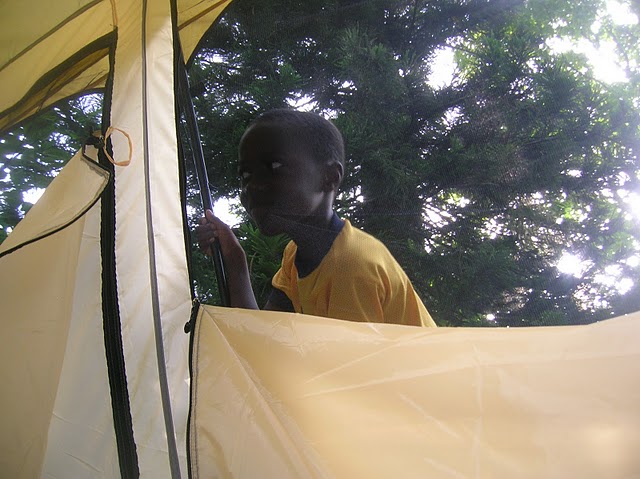
Vansky, Vansky, Vansky- that's how you say his name, and I can't help doing so without a huge smile. He became my precious friend while staying at UCNH, the university in Limbe. I first met Vansky and his older brother Kerry as they wandered over to our tents, which were conveniently set in their backyard. He was a boy of few words, but his big eyes pretty much said everything. As a 7 year old curiosity rules your world, and his was running rampant. He showed up to our tent every morning while we'd get ready. I would stand outside by a picnic table, with all my toiletries. Vansky enjoyed pulling out each item one by one. I would share what it was called in English and he would quickly repeat saying toothpaste, lotion, hair brush, etc. After a couple days of watching me, he began to mimic my daily routine. I'd pull out the lotion and all of a sudden he had it all over him, then he would grab the brush and comb his hair, and he even shoved some q-tips in his ears (from the looks of things that may have been the first time).

Our morning visits were soon followed by evening greetings. I could count on seeing Vansky running up within 30 seconds of the truck rolling onto campus. He'd spring into my arms, or jump on my back like a monkey. At one point we left the university for a week, and I was definitely having Vansky withdrawals. Upon our return he was there with the biggest and tightest hug I had ever received.

How could you not fall in love with this kid? Well if you ask my other teammates they'd tell you that having little kids rummage through your bags is not fun. Even though he was the charmer, he and his brother could be quite mischievous. When he wasn't causing trouble, he would simply entertain himself. One day he got out a bunch of coloring books and a couple pencils. I thought it was strange that he wanted to color with pencil. Instead he laid out all the books and began to bang on them with his pencils bopping his head back and forth--he was playing the drums.

I definitely loved on this little guy, especially when he would sing to me. He taught me a song that he had learned in Sunday school called, "Making Melodies in My Heart". It is officially my favorite song! There was something special about Vansky and it wasn't until our way to the airport that I learned of his family history.

Vansky, his older brother, mother and father were in the Port-au-Prince earthquake. They were all safe, but their world was forever changed. His father left the family and his mother had the children shipped to their aunts and uncles, one of his uncles being the dean of the university. His mother is still in Port-au-Prince working on getting papers for them to move to the US with their grandparents. Vansky is growing up without the two most important people in his life, and he is looking for affection and stability. The last 7 months have been an extreme transition for him.

Saying goodbye to him was not easy. I forewarned him that we would be leaving the next day and he quickly scrambled to give me a gift. Initially he handed me a stuff animal lobster, but his brother immediately reclaimed it since it wasn't Vansky's to give :). So Vansky ran and handed over a little crab. I tried to give it back, but he wasn't having it. I promised to take pictures of the crab during my travels and send it to him.

Before the truck pulled away on our final day, Vansky was there, but it took more effort to get him to smile. I was able to get a quick hug, but he wouldn't look at me--which I was thankful for since I was holding back the tears. He quickly ran away, trying not to look, but we did get a final wave. I know that having people come in and out of your life is difficult, especially at such a vulnerable age. Vansky's smile and laughter are contagious, and I have no doubt that he will find MANY people to continue to love on him.